
Queue Management System Features to Look for in 2026 and Beyond
Updated: Jul 31
Customer expectations in Abu Dhabi have changed significantly, with people seeking faster, more convenient, and digitally enabled services across government offices, hospitals, banks, retail stores, telecom centers, and educational institutions. Investing in the right queue management system features helps organizations reduce wait times, improve staff productivity, and deliver seamless customer experiences. As a trusted provider of smart queue management solutions in Abu Dhabi, KeenTeQ delivers scalable, industry-specific systems that streamline customer journeys, enhance operational performance, and support long-term business growth.

Why Queue Management Systems Matters in 2026
Changing Customer Expectations
Today's customers value convenience as much as the quality of service itself. They expect organizations to minimize waiting times while providing digital-first interactions throughout their service journey.
Key customer expectations include:
Faster service delivery
Digital appointment booking
Mobile notifications
Reduced physical waiting areas
Transparent wait-time information
Contactless customer interactions
Businesses that fail to meet these expectations often experience lower customer satisfaction and reduced operational efficiency.
The Role of Smart Queue Management
Modern queue systems do much more than organize waiting lines. They serve as intelligent customer service platforms that improve operational efficiency while supporting broader customer experience management initiatives.
Benefits include:
Higher customer satisfaction
Improved staff productivity
Better workload distribution
Real-time operational visibility
Enhanced service quality
Improved customer experience management
What Is a Queue Management System?
Understanding Modern Queue Technology
A queue management system is a technology solution designed to organize, monitor, and optimize customer waiting experiences. Rather than relying on traditional first-come, first-served lines, a digital customer queue management system intelligently manages customer flow using electronic tickets, virtual queues, appointment scheduling, and real-time monitoring.
The system typically works by:
Registering customer arrivals
Assigning queue numbers or appointments
Routing customers to the appropriate service counter
Displaying queue progress in real time
Sending notifications when customers are about to be served
Recording service performance for reporting and analytics
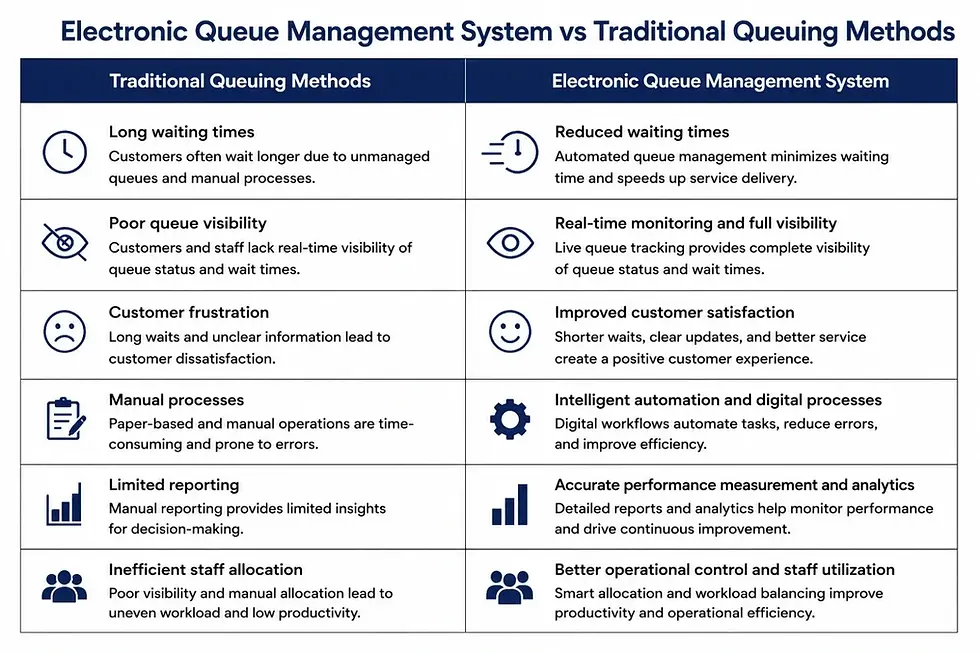
Unlike traditional queuing methods, intelligent systems provide complete visibility into service operations while significantly improving customer convenience.
Industries Benefiting from Queue Management
Modern queue management systems provide measurable benefits across multiple industries, including:
Government service centers
Healthcare facilities
Banking institutions
Retail stores
Educational institutions
Hospitality businesses
Telecom service providers
Customer support centers
Essential Queue Management System Features to Look for in 2026
Selecting the best queue management system requires evaluating features that improve both customer experience and operational efficiency.
1. Virtual Queue Management Solutions
One of the most valuable innovations is the adoption of virtual queue management solutions, allowing customers to wait remotely instead of standing in physical lines.
Important capabilities include:
Mobile queue booking
Remote waiting
Online appointment scheduling
Estimated arrival times
Reduced congestion
Better customer convenience
Virtual queues significantly reduce overcrowding while improving customer satisfaction.
2. Self-Service Ticket Queue System
A modern ticket queue system should simplify customer registration through multiple self-service options.
Essential features include:
Digital token generation
Interactive kiosks
QR code check-ins
Touchless registration
Multi-language interfaces
Customers can register quickly without requiring staff assistance.
3. Real-Time Queue Monitoring
Managers need complete visibility into queue performance.
Look for features such as:
Live queue tracking
Wait-time estimation
Counter monitoring
Queue performance dashboards
Staff productivity monitoring
Service-level reporting
Real-time monitoring enables organizations to make informed operational decisions instantly.
4. Customer Notifications and Alerts
Keeping customers informed reduces frustration and improves the waiting experience.
Modern systems should support:
SMS notifications
Mobile app alerts
Email notifications
Queue status updates
Service reminders
Customers can spend their waiting time more productively while staying informed.
5. Multi-Channel Customer Registration
Customers should have multiple ways to join the queue.
Registration channels include:
Walk-in registration
Mobile applications
Website booking
Self-service kiosks
Appointment scheduling platforms
This flexibility improves accessibility while reducing front-desk congestion.
6. Advanced Analytics and Reporting
Data-driven decision-making has become essential for service improvement.
Reporting capabilities should include:
Customer flow insights
Wait-time analysis
Service efficiency reports
Counter utilization
Peak-hour analysis
Resource planning reports
Analytics help organizations continuously optimize service performance.
7. AI-Powered Queue Optimization
Artificial Intelligence is transforming queue management through intelligent automation.
Advanced AI capabilities include:
Predictive demand forecasting
Automated customer routing
Smart counter allocation
Peak-hour optimization
Dynamic queue balancing
AI helps organizations maximize efficiency while improving customer experiences.
How Queue Management Systems Improve Customer Flow Management
Streamlining Customer Journeys
Effective customer flow management ensures customers move efficiently through every stage of their visit.
Benefits include:
Organized service delivery
Reduced bottlenecks
Balanced workloads
Better queue visibility
Improved resource utilization
This creates faster, more predictable service experiences.
Enhancing Customer Experience Management
Queue management directly contributes to stronger customer experience management by reducing stress and uncertainty.
Advantages include:
Personalized service
Shorter perceived waiting times
Improved communication
Better customer engagement
Higher customer satisfaction
Customers feel informed and valued throughout their visit.
The Growing Role of Visitor Management Integration
Combining Queue Management with Visitor Management Systems
Modern organizations increasingly integrate queue systems with a visitor management system to streamline visitor experiences from arrival through departure.
Integrated capabilities include:
Visitor registration
Appointment verification
Visitor identification
Digital check-in
Automated visitor records
This creates a seamless customer journey while improving operational efficiency.
Benefits of Visitor Tracking System Integration
Integrating a visitor tracking system provides additional operational and security advantages.
Key benefits include:
Enhanced security
Accurate visitor records
Improved visitor experiences
Better compliance
Facility management insights
Real-time visitor monitoring
Organizations gain greater visibility into visitor movement while maintaining secure facilities.
Factors to Consider When Choosing the Best Queue Management System
1. Scalability for Future Growth
Choose a solution that can grow with your business and support future expansion.
Multi-location deployment
Cloud-based management
Enterprise scalability
Centralized administration
2. Ease of Integration
Ensure the system integrates seamlessly with your existing business applications.
CRM platforms
ERP systems
Appointment scheduling software
Visitor management systems
Business intelligence platforms
3. User-Friendly Interface
Select a solution that provides a simple and intuitive experience for both customers and staff.
Intuitive interface
Simple customer registration
Easy counter operation
Interactive dashboards
4. Customization Capabilities
Look for a system that can be tailored to your organization's unique workflows and branding.
Industry-specific configurations
Branding customization
Flexible reporting
Configurable workflows
Multi-language support

Why KeenTeQ Is a Preferred Queue Management System Provider in Abu Dhabi
KeenTeQ delivers intelligent, scalable, and customer-focused queue management solutions that help organizations improve service efficiency and customer satisfaction across various industries.
Industry-Specific Expertise: KeenTeQ designs customized q management solutions tailored to the unique workflows and operational needs of different industries, ensuring efficient and scalable implementations.
Advanced Technology Solutions: Our future-ready solutions include virtual queue management, smart automation, AI-powered optimization, and real-time analytics to streamline customer service operations.
Comprehensive Support Services: From consultation and queue management system installation to maintenance, upgrades, and technical support, KeenTeQ provides complete lifecycle assistance for reliable system performance.
Commitment to Customer Success: KeenTeQ helps businesses improve customer flow management, increase operational efficiency, and deliver exceptional customer experiences while supporting long-term growth.
Conclusion
As customer expectations continue to evolve in 2026 and beyond, investing in an intelligent queue management system is essential for organizations across Abu Dhabi. With features such as virtual queuing, AI-powered optimization, real-time analytics, and visitor management integration, modern solutions enhance customer experiences, improve operational efficiency, and support long-term digital transformation. KeenTeQ delivers customized, future-ready queue management solutions that help businesses streamline operations and achieve service excellence.
Contact KeenTeQ today to schedule a consultation and discover how our advanced queue management solutions can improve customer satisfaction and optimize your service operations.
FAQ
What are the features of a queuing system?
Modern queue management systems include virtual queuing, digital ticket generation, self-service kiosks, appointment scheduling, real-time monitoring, customer notifications, AI-powered routing, advanced reporting, and analytics that improve service efficiency and customer satisfaction.
How does an electronic queue management system improve customer experience?
An electronic queue management system reduces waiting times, provides accurate queue updates, enables remote waiting, improves communication through notifications, and delivers a more organized, transparent, and convenient service experience.
What is the difference between a traditional queue and a virtual queue management solution?
Traditional queues require customers to wait physically in line, whereas virtual queue management solutions allow customers to join the queue remotely using mobile devices or online platforms while receiving real-time updates about their service status.
How does a ticket queue system work?
A ticket queue system assigns customers a digital or printed queue number through a kiosk, mobile application, QR code, or website. The system then automatically manages the queue, directs customers to available service counters, and displays queue progress in real time.
How do queue management system providers support businesses after installation in Abu Dhabi?
Leading queue management system providers offer consultation, professional installation, system configuration, software updates, preventive maintenance, technical support, staff training, and ongoing optimization to ensure reliable long-term performance.


